
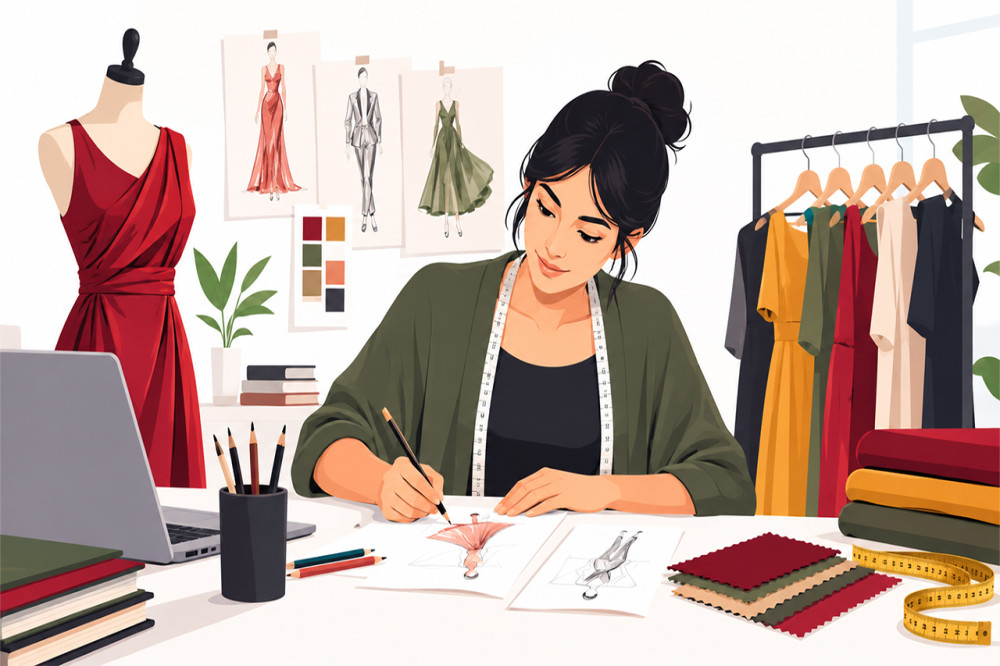
Every outfit you own — the cut, the fabric choice, the way a sleeve is stitched to fall a certain way — was decided by someone sitting at a desk long before it reached a store. Fashion designing looks like pure creativity from the outside, sketchbooks and mood boards, but the actual profession is a demanding mix of art, technical construction, business sense, and relentless deadlines. It is also one of the few creative careers in India with a clearly mapped entrance-exam route, a large formal education ecosystem, and genuinely wide-ranging outcomes — from a modest starting salary to designers who run their own multi-crore labels. This blog lays out exactly what a fashion designing career in India involves, how to become a fashion designer in India, and what it realistically pays at each stage.
A fashion designer conceptualises and creates clothing and accessories by applying art, aesthetics, and technical construction — deciding on shape, fabric, colour, and trims for every garment, often for an entire seasonal collection at once, not just a single piece. In simple terms: while people imagine sketching as the whole job, a real design career includes fabric sourcing, pattern-making, understanding garment construction, managing production timelines, and increasingly, digital design tools and sustainability considerations.
The field today is far broader than the single "designer sketching dresses" image most students start with. Careers in fashion span design studios and fashion houses, retail chains, e-commerce platforms, textile manufacturing, film and television costume production, and fashion media and styling — meaning a student entering this field has considerably more career-path options than just "become a designer" in the narrow sense.
The industry itself is genuinely large and still growing. India's fashion and apparel industry, valued at roughly ₹1.5 lakh crore, is projected to keep expanding significantly, creating demand for a substantial number of newly trained designers every year — this is not a shrinking, oversaturated field despite how competitive entrance exams can feel.
There is a well-established, respected entrance-exam pathway into the field. Unlike some creative careers with no formal gatekeeping process, admission to premier institutes runs through recognised national-level exams — NIFT's own entrance exam, NID's DAT, UCEED, and CEED among others — giving students a clear, structured target to prepare for rather than an ambiguous "build a portfolio and hope" route.
Career paths are genuinely diverse, not limited to one job title. Beyond the traditional "fashion designer" title, the field includes merchandising, buying, styling, textile design, fashion communication, and increasingly, digital and e-commerce-focused fashion roles — meaning a student with an interest in business, media, or technology can still build a fashion career without being purely garment-focused.
Earning potential at the top is genuinely exceptional. While entry-level pay is modest, top celebrity fashion designers in India — names like Manish Malhotra, Sabyasachi, Ritu Kumar, and Tarun Tahiliani — are reported to earn up to several crore rupees per annum, showing just how high the ceiling goes for designers who build a strong personal brand and client base over time.
Multiple structured routes exist depending on how much time and investment you are ready to commit. A short-term diploma in fashion design offers the fastest entry path after Class 12, while a full B.Des or B.F.Tech from NIFT provides the broadest long-term career access — meaning this field accommodates students with very different timelines, budgets, and risk appetites.
Step 1 — Class 12 stream does not matter, but creative ability does. There is no fixed stream requirement for fashion designing courses after 12th. Entrance exams typically test a combination of General Ability (English, Maths, General Knowledge) and Creative Ability (sketching, visualisation, design sensibility) — meaning students from Science, Commerce, or Arts can all realistically compete, provided they build genuine sketching and visual-thinking skills alongside academics.
Step 2 — Decide between the diploma route and the full degree route early. A short-term Diploma in Fashion Design is the fastest way to enter the industry after Class 12 for students who want to start working sooner, while a full Bachelor's degree (B.Des or B.F.Tech) from a premier institute like NIFT offers considerably broader long-term career access and stronger brand recognition on a resume.
Step 3 — Prepare specifically and early for the relevant entrance exam. With over 12 national and state-level entrance exams currently accepting applications for fashion design courses — NIFT, NID DAT, UCEED, CEED, and CUET UG among the most sought-after — students aiming for a top institute are generally advised to start focused preparation at least 6 to 12 months before the exam, since acceptance rates at the most competitive exams currently sit below 10%.
Step 4 — Build a genuine sketching and design portfolio alongside exam preparation. Since creative ability carries as much weight as general aptitude in most entrance exams, and portfolios matter even more heavily at later career stages, developing real sketching, fabric-sense, and visual-design skills from early on gives a meaningfully stronger foundation than academic preparation alone.
Step 5 — Choose your specialisation deliberately once inside your programme. Design programmes typically allow specialisation across areas like apparel design, knitwear, leather, accessories, or textile design — professionals who declare and commit to a clear specialisation, and continue building a standout portfolio in it, are consistently reported to see stronger placement and salary outcomes than generalists.
Step 6 — Use internships and industry projects to build real, employable experience. Internships with design studios, textile companies, or fashion brands during the course provide the kind of hands-on production and industry exposure that classroom learning alone cannot fully replicate.
Step 7 — Decide your long-term direction: brand employment, freelancing, or launching your own label. Fashion careers branch significantly after a few years of experience — some designers build steady careers within established brands and retail houses, some move into freelance styling or design consulting, and others eventually launch their own label, which tends to carry the highest potential reward alongside considerably higher risk and inconsistent early income.
A fashion design education opens into several distinct career roles, not just one job title:
Fashion graduates find roles across a wide range of employers, including:
It is worth being realistic here: starting pay after even a premier institute like NIFT is genuinely modest compared to some other professional degrees. Industry sources are consistent in describing this first salary as a launchpad rather than a verdict on long-term earning potential — the steepest growth comes from portfolio strength, specialisation choice, and reputation built over years, not from the starting job title alone.
This path tends to suit students who:
Fashion designing rarely gets explained to students beyond the glamorous surface image — yet the real career is built on structured entrance exams, years of technical skill-building, and patient brand or portfolio development, much like any other serious profession. For a student who genuinely loves the craft of design, is willing to put in the disciplined groundwork, and understands that starting pay is a launchpad rather than a final destination, fashion designing remains one of India's most creatively rewarding and increasingly diverse career paths.
Confused about which career path is right for you? Let Career Map guide the way.
Visit us at www.thecareermap.in
Career Map — Guiding Careers, Shaping Futures.
https://www.lpu.in/blog/career-paths-after-bsc-fashion-design/
https://www.iwpacademy.com/blog/turn-your-creativity-into-a-fashion-career-delhi
https://siba.edu/fashion-design-creativity-and-opportunity/
https://www.universalai.in/career-in-fashion-designing-a-creative-path-to-success/
https://www.lpu.in/blog/career-paths-after-b-design-fashion/
https://mitwpu.edu.in/blog/why-choose-fashion-designing-as-a-career



Hello !!
I'm a Career Bee